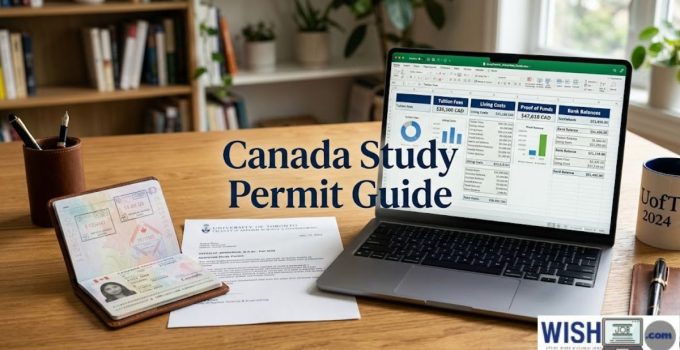
When you choose to study in Canada, you are gaining access to an exceptional standard of living and massive career opportunities. People from all over the world come to study in Canada due to its welcoming environment and robust academic infrastructure. According to Immigration, Refugees and Citizenship Canada (IRCC), there were over 1 Million international students in Canada recently in 2023.
Navigating the Canada study permit process requires understanding exactly how the Canadian study visa operates. Officially known as a Study Permit, this document allows foreign nationals to undertake their studies in Designated Learning Institutes (DLI). These are specific institutions approved by a provincial or territorial government to host international students.
The Canadian government has recently introduced strict limits on study permits to manage incoming student volume. Under these modern guidelines, it is expected that approximately 360,000 new study permits will be issued to international students annually. This makes it more critical than ever to ensure your application meets every strict benchmark on your first attempt.
One of the biggest recent updates involves the introduction of a provincial attestation letter (PAL). Most students will now be required to upload a provincial attestation letter (PAL) from the province or territory where they plan to study alongside their application.
Critical Compliance Warning: You must secure your PAL directly from your chosen province or territory before submitting your application. Failing to upload this document when required will result in an immediate rejection or return of your application package.
Beyond the immediate academic benefits, completing your program opens doors to long-term career growth. After finishing your studies at an eligible institution, you can apply for the Post Graduate Work permit, allowing you to gain valuable local employment experience.
Eligibility Requirements of a Canada Study Permit
To successfully transition to a Canadian institution, you must satisfy specific criteria set by immigration authorities. You can apply for the Study permit and come to Canada if you meet the baseline operational conditions.
First, you must have received an official offer letter from a recognized Designated Learning Institute (DLI). Checking the verified list of DLI status is essential, as only these approved entities can legally host foreign nationals.
Second, you must provide absolute proof of financial resources demonstrating that you can pay for your tuition and living expenses. The minimum required financial proof of support has increased significantly, shifting from the historical $10,000 threshold up to $20,635 as of 1st January 2024.
Additionally, you must secure a clean Police Clearance Certificate to satisfy safety protocols and undergo a Medical Exam if your country of origin or specific program requires it. Finally, you must explicitly satisfy or prove to the assigned Visa officer that you will willingly leave Canada when your authorized study permit expires.
| Requirement Category | Core Financial Threshold | Mandated Action / Exemption |
| Standard Cost of Living Proof | $20,635 minimum baseline | Required for all standard applicants |
| Provincial Attestation (PAL) | No additional fee | Required for undergraduate and college programs |
| Advanced Degree Exemption | Variable by institution | Automatically exempt from PAL requirements |
The modern financial requirement demands a baseline of $20,635 in provable liquid assets, reflecting updated calculations to ensure you can fully support yourself during your academic tenure.
A List of Documents to Prepare
Gathering your paperwork beforehand ensures a seamless application journey. You should always ensure you have all the documents you need well before you plan to travel to Canada.
Your initial file must contain your official Proof of Acceptance Letter from your designated school. You must also include your provincial attestation letter (PAL), though this specific document is not required if you are applying for a full-time master’s or PhD degree program.
Your personal identification dossier must feature high-quality proof of identity documents, including a valid national ID Card and a valid Passport. Alongside this, bundle your comprehensive Proof of Financial Resources to match the updated limits.
Industry Standard Note: Your application should always include a detailed letter of explanation. This personal statement clarifies your academic goals, explains any career gaps, and clarifies your intent to return home upon graduation.
Processing Times and Expedited Streams
The average processing time for standard applications heavily depends on your location and the complexity of your file. On average, it takes up to 14 weeks to process the full visa application from outside the country.
However, eligible students can access an expedited processing pathway for a faster decision on their study permit. You can secure an accelerated visa decision in just 20 days through the Student Direct Stream (SDS) if you hold citizenship in specific designated regions.
-
Americas: Antigua and Barbuda, Brazil, Colombia, Costa Rica, Peru, Saint Vincent and the Grenadines, Trinidad and Tobago.
-
Asia & Middle East: China, India, Morocco, Pakistan, the Philippines, Vietnam.
-
Africa: Morocco, Senegal.
How to Apply From Outside Canada
You must submit your entire application online before making any travel arrangements. The entire Canada study permit process is handled digitally through the dedicated electronic IRCC Portal.
Once you have verified your eligibility and compiled your files, select your home country within the digital platform to load local instructions. Read the provided application guide carefully and prepare your detailed answers before populating the form fields.
After submitting your forms and paying the required processing fees, you must book an appointment to give your biometrics at an authorized collection point. If required based on your geographic origin or background, schedule and complete your mandatory medical exam promptly.
The Study Permit is Not a Visa
It is vital to understand that an approved study permit does not function as an entry visa. When your application is approved, you will first receive a formal letter of introduction confirming your authorization to study.
This physical letter is NOT your actual permit. You must bring this document with you when you travel and present it directly to the border immigration officer at the port of entry to receive your actual study permit.
Concurrently, the system will automatically issue either an electronic travel authorization (eTA) or a temporary resident visa (TRV) based on your citizenship. If you are from a country that requires a visitor visa, the TRV Visa will be securely placed inside your passport to grant you entry into the country.
Because guidelines can update rapidly, checking the official Immigration, Refugees and Citizenship Canada (IRCC) website is always the best path to ensure total alignment with the newest procedural standards.